Puyo
Puyo
Capital of Pastaza and gateway to Ecuador's Amazon rainforest, Puyo combines jungle, Kichwa Canelos communities and hidden cascades.
Considered one of the gateways to the Amazon rainforest, Puyo stands as one of the best bases for organized excursions in the region. Its natural beauty, recently discovered, is beginning to captivate countless travelers. Indeed, it remains an unmissable crossroads for jungle expeditions and forest reserves.
History
The word Puyo derives from Quichua, meaning cloudy. The city of Puyo is often called "La Ciudad Nieblina" or El Puyo. It was officially founded in 1899 by a Dominican Catholic priest known as Alvaro Valladares, with the help of nine indigenous Canelos. While traveling between the Baños region and Canelos, they were searching for a place to rest. Seduced by the landscape's beauty, they decided to stay permanently. They built three large huts with a wooden cross and celebrated Mass, entrusting the region's people to the Virgin Mary.
Today
Situated on the banks of the Amazon Basin, between the cities of Baños, Tena, and Macas, 155 km south-southeast of Quito, Puyo is the capital of Pastaza province. Its population numbers approximately 24,430 inhabitants with an average density of 420 per km².
Puyo is an important commercial hub and a thriving river port city. Skirting the right bank of the river bearing its name, it serves as the gateway to the Baños region as well as several other Amazon towns. The most advanced river port in the Pastaza region is located here and ensures the transport of regional products.
Although commerce flourishes thanks to this river port, the city's economy depends primarily on rubber production, tropical fruits, and sugarcane, as well as forestry. Thanks to its proximity to the Amazon rainforest, Puyo is increasingly capturing the hearts of travelers drawn to its natural landscapes.
Puyo is also considered a cultural capital of the Pastaza region. Every year, a few days before Lent, its inhabitants celebrate Puyo Carnival, the most famous Ecuadorian festival. According to tradition, the celebration combines neighborhood festivities and water fights. Other major cultural celebrations such as Ecuadorian Amazon Day and the Chonta Palm Festival are also held here. Organized on February 12th, Ecuadorian Amazon Day is a commemoration of the discovery of the Amazon in 1542 by Francisco de Orellana.
The tourism sector in the Puyo region remains underdeveloped to date. Initiatives to create ecotourism opportunities—including ethnic, cultural, ecological, and adventure activities—are primarily led by OPIP (Organización de Pueblos Indígenas de Pastaza). This is an indigenous local organization controlling much of Pastaza territory.
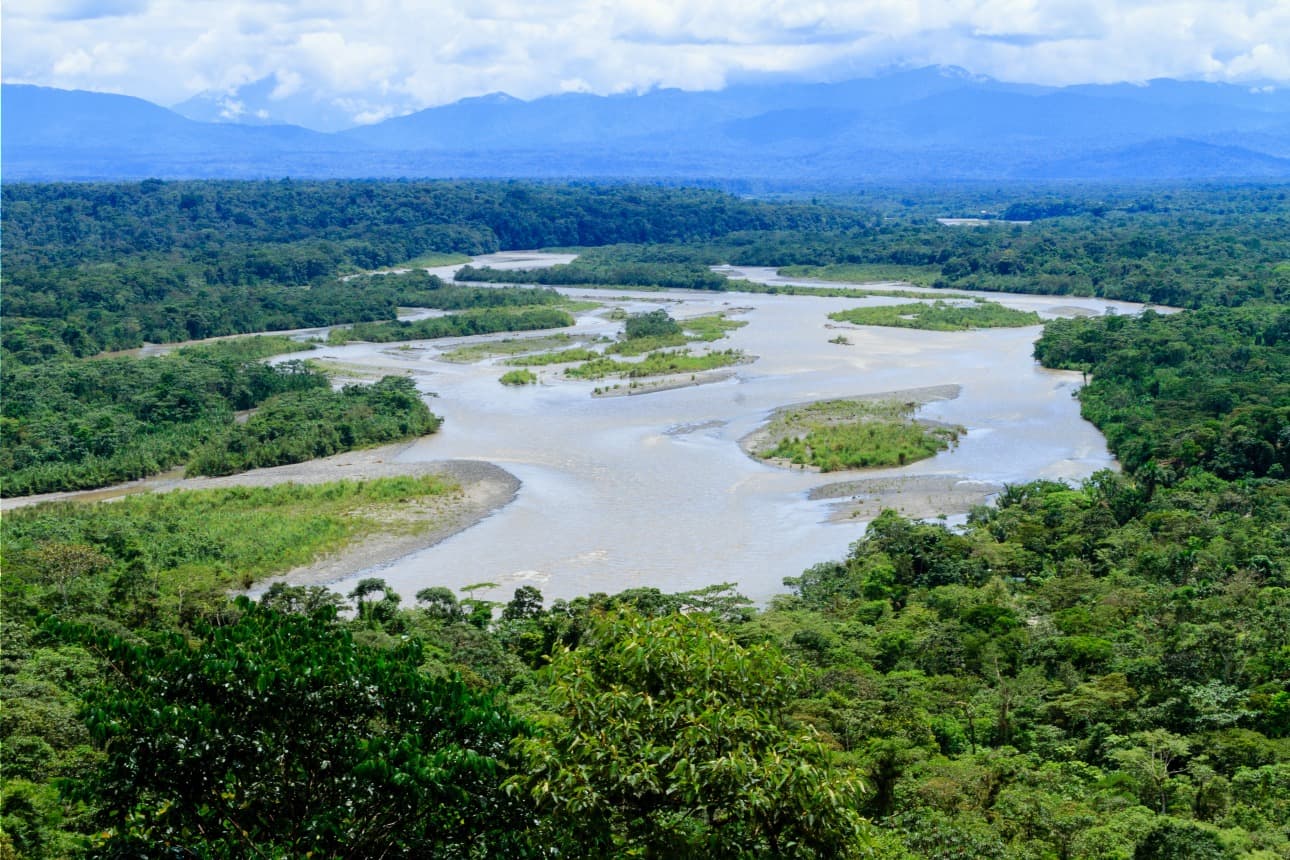
Puyo is surrounded by mountains, forests, rivers, and natural valleys extraordinarily rich in biodiversity. A section of the Amazon jungle flourishes right at the city's entrance.
The water park Morete Puyo ranks among the city's most popular destinations. Located in the Libertad neighborhood, this leisure park boasts Ecuador's tallest water slides. Combining nature with cutting-edge technology, it offers visitors an Olympic swimming pool, an artificial wave pool, and water jets.
The Omaere Ethnobotanical Park is South America's first ethnobotanical park. This place is a goldmine for scientists wishing to study the relationship between humans and nature.
Climate
Perched above 950 meters in elevation, the Puyo region enjoys, according to the Köppen-Geiger classification, a warm, humid oceanic climate with no dry season. In a year, it records average precipitation of 322.3 mm. During the wettest month of the year (February), precipitation averages 48.3 mm, while in the driest month, it reaches 6.4 mm.
Throughout the year, temperature remains consistently stable, averaging around 14.2°C. In the coldest month (July), it barely drops to 13.2°C.
- Plane
The nearest airport to Puyo is located approximately 10 km to the northwest in the small town of Shell. Daily, private and commercial flights depart from the airport to ensure connections.
- Bus
From Puyo, numerous buses depart daily toward other Ecuadorian cities. Puyo is thus connected to Amazon towns via the Ambato-Tena-Macas route. Buses follow this route to Ambato, Baños, Coca, Guayaquil, Macas, Quito, and Tena.
To get around the city, the best option is to take a taxi. A ride from downtown to the bus terminal costs approximately $1 USD. It's also possible to take small local buses departing every 30 minutes from the terminal south of the market along Calle 27 de Febrero.
Want to discover this destination?
Our local advisors design your tailor-made trip.