Cochasqui
Cochasqui
Just 30 km from Quito, Cochasqui reveals 15 Quitu-Cara pyramids perched at 3,040 m, facing the Cayambe volcano. A still-hidden pre-Incan site.
Located approximately 30 km northeast of Quito in the Pedro Moncayo canton (Pichincha province), Cochasqui is an archaeological park. Steeped in history, this site ranks among the most significant natural and archaeological heritage areas in northeastern Pichincha. Through its various attractions, it showcases the technological and scientific development of pre-Incan culture. It's a refreshing destination for anthropological tourism.
History
Most of the pyramids and other structures at Cochasqui were built by the Quitu-Cara peoples between 950 and 1530, during the Spanish conquest. The Quitu-Cara governed the mountainous region of northern Equador. After founding the city of Quito, this people were defeated by the Incas and integrated into their empire in 1492.
Archaeological studies on Cochasqui are divided into two periods. Cochasqui I, spanning 950 to 1250, and Cochasqui II between 1250 to 1550. Led by Max Uhle, a German archaeologist, the most significant excavation of the site took place in 1933. Work was continued in 1964 by another German archaeologist named Udo Oberem with the help of an Ecuadorian colleague.
According to archaeologists, the Cochasqui complex was once a ceremonial and astronomical center used for meteorological purposes to calculate solstices. The flat-topped pyramids were thus the residences of rulers and the kingdom's elite, while the tolas were used as funerary mounds.
The pyramids were designated UNESCO World Heritage in 1979. To maintain the integrity of the site and ensure the promotion of scientific research, conservation, and restoration, Cochasqui was placed under the administration of the Pichincha Provincial Council.
Today
Dominating a vast area of 840,000 m², Cochasqui is one of the most important and largest complexes of the pre-Incan Empire. It once housed numerous pyramids, which today stand as ruins. The site also includes several small museums including archaeological museums, two ethnological museums, and a musical instruments museum. Nature enthusiasts can enjoy the botanical garden.
Cochasqui contains 15 truncated pyramids and 21 quadrangular mounds, commonly known as Tolas. Among these pyramids, 9 are built with ramps and 6 without. The pyramids themselves are designed in the form of quadrangular prisms using blocks of volcanic stone called cangahua; this is indeed a material highly vulnerable to weathering and erosion. The reason these pyramids are still visible today is solely due to the tall grasses and earth that cover and protect them.
The Tolas were used in the past as funerary mounds. Over time, these structures were places dedicated to religious rituals. During excavations organized by German archaeologist Max Uhle across several Cochasqui sites, more than 556 skulls were found at one location. These discoveries reveal the Quitu-Cara burial ritual process.
Some archaeologists also suggest that the largest pyramid was, in its heyday, a site of human sacrifice.
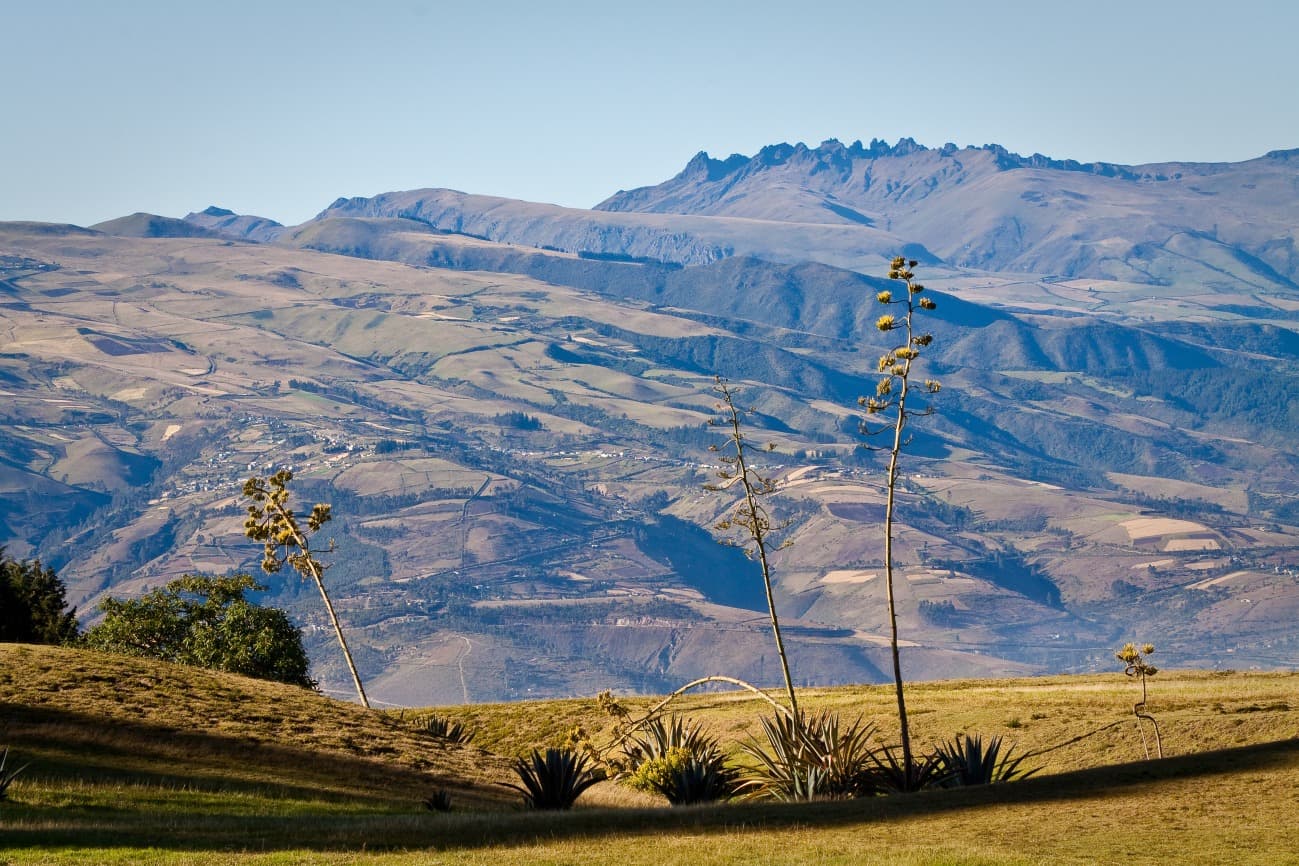
Located in the northern Andes, 5 km from the equatorial line, Cochasqui stands at over 3,040 m elevation. It is dominated by the Mojanda volcano (4,263 m). This is why, on clear days, a visit promises breathtaking views across the entire site, the Pinchincha Pambamarca valley, the Cayambe volcano, and Cotopaxi.
The Cochasqui complex features several museums of different themes that preserve the history of the pre-Incan Quitu-Cara community. Through an open-air ethnographic museum, it displays various objects highlighting the lifestyle of ancient Cochasquians. During your visit, it will also be particularly worthwhile to explore the small archaeological museum located on the eastern side of the site. Archaeologists have discovered artifacts from Colombia on the site. They have also uncovered instruments such as a flute made from llama bone, as well as countless jars, bowls, statues, and other objects in stone and ceramics.
Today, the Cochasqui complex features a large farm housing domesticated and farm animals such as llama-alpacas called guariso. According to local belief, llamas were sacred to Andean ancestors, explaining their abundant presence in the region. The farm is also visited by wild animals that come to feed, such as skunks, rabbits, partridges, doves, wolves, condors, eagles, and pumas. Several tree species typical of the region cover the site, including Puma Maqui, Myrtle, Sacha-Rosa, Capote, alder, and orchids.
From Quito, which lies 45 minutes to the south, it is easiest to reach the site by following the North Panamerican Highway. Along the route, signs indicate where to exit. After leaving the highway, it takes only 15 minutes on foot along a dirt path to reach Cochasqui.
Hours and Admission
The Cochasqui complex is open daily from 8:30 a.m. to 4:30 p.m. Admission fees are $3 USD for adults, 20 cents for youth and seniors. For Ecuadorian citizens, admission is $1 USD.
Want to discover this destination?
Our local advisors design your tailor-made trip.