Ambato
Ambato
Nestled at 2,577 m between Cotopaxi and Tungurahua, Ambato cultivates the art of fruit, flowers, and literary heritage. Our complete guide to visiting.
A major Ecuadorian city rising above 2,500 m, Ambato is surrounded by lush, towering mountains. If there is one place where color, splendor, and good cheer vibrate through the streets each year, it is undoubtedly Ambato. The capital of Tungurahua Province comes alive annually for the emblematic Fiesta de la Fruta y las Flores. Discover Ambato, poetically known as the "City of Flowers and Fruits" or the "Garden of Ecuador".
A Dive into Ambato's History
Ambato, originally called San Juan de Ambato, is a city in central Ecuador. Before the Inca conquest, Ambato was an autonomous state inhabited by indigenous peoples from the Amazonian region.
These indigenous groups bore exotic names such as Píllaros, Panzaleos, Huapantis, Izambas, Quisanpichas, and Hambatus. Their descendants had migrated and settled in the Ambato region to take advantage of the fertile lands surrounding the volcanoes of Cotopaxi and Tungurahua.
After founding Quito, Spanish conquistadors decided to occupy Ambato on the orders of Benalcázar. They subdued the Inca rebels, then led by the valiant Rumiñahui. The city, whose name means "the hill of the frog," was officially founded on December 6, 1535 by Sebastián de Benalcázar on the right bank of the Ambato River.
Unfortunately, a devastating earthquake on June 20, 1698, completely destroyed Ambato, killing 6,000 people. The city was rebuilt on Quisanpichas indigenous lands on December 6, 1698, but traces of colonial architecture disappeared.
The fertility of surrounding lands allowed Ambato to revive its economy. However, another earthquake damaged much of the city again on February 4, 1797.
After Ecuador's independence on November 12, 1820, the city experienced sustained economic growth thanks to agricultural resources. Unfortunately, Ambato was devastated once more by an earthquake on August 5, 1949. The city rose from its ashes again thanks to the faith of its inhabitants. They wished to build a "garden city" where life flourishes, despite recurring eruptions and earthquakes affecting the Tungurahua and Cotopaxi volcanoes.
The country's first printing press was established in Ambato in the 17th century. It was here that Ecuador's first newspaper was published. Since then, Ambato has become a major hub for print media distribution in Ecuador.
Equador also achieved independence thanks to a group of armed patriots led by Cipriano Delgado. This group spearheaded a genuine revolutionary movement. Subsequently, the army commanded by Antonio José de Sucre intervened to liberate Ambato from Spanish rule, even before the great Battle of Pichincha.
According to the 2010 census, the National Institute of Statistics and Censuses counted 450,000 inhabitants in Ambato, making it the fifth-largest city in Ecuador.
Ambato Today
Here are the main neighborhoods of modern Ambato:
Ficoa Alto, located north of the city, is Ambato's most beautiful neighborhood. Its streets are pleasantly lined with fruit trees and charming restaurants serving typical dishes such as llapingachos and fritada.
Atocha is probably Ambato's oldest neighborhood. It is mainly known for housing the Quinta Juan León Mera estate, spanning 9 hectares with a magnificent 2.5-hectare botanical garden. At the city's northern edge, Atocha is also famous for colada morada, the spiced Ecuadorian beverage traditionally enjoyed with bread.
Why Visit Ambato?
Situated along the river of the same name, 128 km south of Quito, Ambato lies at the heart of the Ecuadorian Andes Cordillera, perched at 2,577 m altitude. Surrounded by verdant peaks and volcanoes, Ambato is a prime tourist destination.
Monuments and Historic Sites:
The Ambato Cathedral, inaugurated on December 12, 1954, is the city's most elevated and symbolic edifice, featuring a sumptuous dome. This cathedral was built in 1952 on the remains of a church constructed during Ambato's second founding in 1698. Pigeons nicknamed the "Guardians of the Temple" entering and exiting through the cathedral's openings are its main attractions.
On one side of the square where the Basilica stands, discover the Casa Montalvo. The relics of Juan Montalvo, the giant of Ecuadorian literature and fierce opponent of dictators Gabriel García Moreno and Ignacio de Veintemilla, are preserved here. Deceased in Paris on January 17, 1889, his body was displayed in the mausoleum located in the birthplace of Juan Montalvo in Ambato, a building featuring Greek architectural style. Casa Montalvo houses the Montalvino Museum, divided into 5 exhibition halls: iconography and family objects of the writer, an exhibition on ancient Ambato, a private room, Montalvo's works, and manuscripts.
Near Montalvo Park, the Casa del Portal stands before you, one of the rare colonial remnants that survived the 1949 earthquake. Built in 1900, this house is a historic monument of Ambato. From its arcades, you'll have an unobstructed view of the cathedral's dome.
Just beside Casa del Portal, admire the city's great library spanning 3 levels. This library was constructed to bring a touch of modernity to the downtown area. Over 70,000 volumes and computers fill this immense library.
La Merced Church, built in 1800 in flamboyant Baroque style, is also worth visiting. It stands across from the grand La Merced Park and distinguishes itself through architectural elements typical of Ecuadorian colonial times. This chapel forms a beautiful ensemble with its tall tower and the eponymous park.
The Quinta Juan León Mera was the former home of the famous writer and politician Juan León Mera. Flanking the north bank of the Ambato River in the Atocha neighborhood, this 19th-century manor is now open to the public. Colonial furniture and beautiful paintings adorn the manor's interior. All around the building spreads a meticulously maintained botanical garden, where over 257 species of plants and flowers flourish.
The Museo Del Col Nac Bolívar, inaugurated in 1920, will conclude your cultural circuit around Ambato. It welcomes visitors in an elegant building east of Sucre and Lalama streets, specifically in the upper section of Bolívar Superior Institute. The museum's various collections are distributed across 11 exhibition halls. One section displays commemorative medals, banknotes, coins, and photographs of Ecuador in the early 20th century. Another section opens a window onto Ecuador's rich wildlife, while yet another is devoted to botany. You will also see archaeological objects from different Ecuadorian civilizations and marble furnishings from all regions of the country. However, the museum's most interesting section is undoubtedly the ethnographic wing (handicrafts, pottery, sculptures, etc.).
Natural Sites:
Lovers' Park, located near Bellavista Stadium, is the best place for a magnificent aerial view of Ambato. Linger over beautifully trimmed cypress trees and sculptures evoking different historical or imaginary characters. Its bucolic and romantic setting makes this park a particularly popular rendezvous for couples.
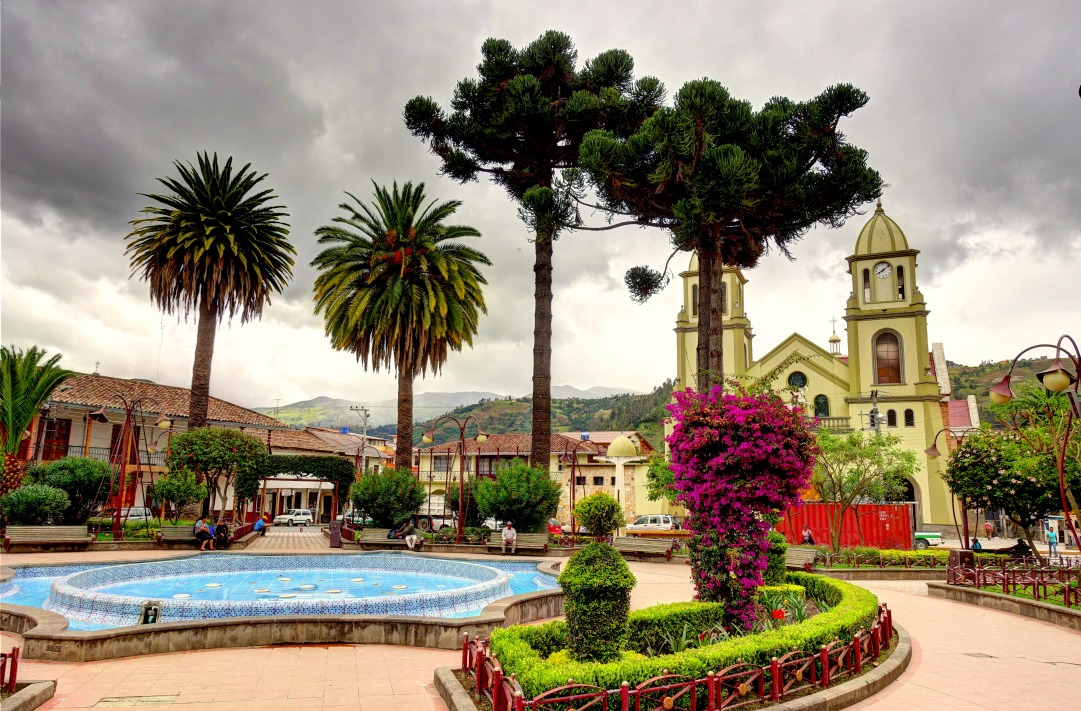
In the city center, don't miss Montalvo Park, named in honor of Ambato's greatest writer, Juan Montalvo. Created in 1905, this park boasts numerous ornamental plants, such as pine, palm, araucaria, and bougainvillea. Designed by architect Pedro Durini, it sits at the intersection of four major Ambato streets: Sucre, Montalvo, Castillo, and Bolívar. The statue of Juan Montalvo, which stands in the park's center, was unveiled in 1911.
The Atocha Botanical Garden or La Liria, also nicknamed the "Garden of Ecuador," is equally worth visiting. Spanning 14 hectares, you'll see different endemic species symbolizing Ecuadorian flora, studied and planted by Juan León Mera and Luis A. Martínez. Among these endemic plants are various eucalyptus varieties.
The Provincial Family Park is ideal for rejuvenating yourself amid nature, with its hiking trails, fields, and vast gardens. On clear days, this park offers a panoramic view of Tungurahua volcano and the entire city.
Ambato is also known for its numerous hot springs, such as La Piscina de la Virgen. This relaxation facility houses 3 natural pools, spas, a hydrotherapy room, and massage cabins. Most intriguingly, it features a hot spring flowing directly from the Tungurahua volcano, blessed with healing properties.
Cultural Events:
Fiesta de la Fruta y las Flores is Ambato's primary cultural celebration. This fruit and flower festival takes place in Ambato each year. Originally created to commemorate the anniversary of the earthquake that struck the city on August 5, 1949, it was officially established on June 29, 1950, and is celebrated in February, even though the earthquake occurred in August. A symbol of identity, solidarity, and national pride, this festival has been classified as a "National Holiday" since 1962. Among the festival's highlights, don't miss the Brotherhood Parade and the Blessing of Bread and Fruits Parade.
Climate in Ambato
Ambato is located 128 km south of Quito, on the Pan-American Highway, in the heart of Ecuador. The city enjoys a warm and temperate climate, with heavy rainfall falling throughout the year, even during the driest months. Annual precipitation, relatively significant, reaches 504 mm. The average annual temperature stands at 14.6°C. November is the warmest month, with an average temperature of 15.4°C. July is the coldest month, with an average temperature of 13.2°C.
Bus is the best way to arrive, with a stop in Latacunga. The bus journey takes two and a half hours from the capital, Quito. Bus companies depart from Quitumbe Terminal to Ambato every 5 minutes. A ticket costs 2.65 USD.
Ambato's terminal is located near the railway station, 2 km from the historic center. The center can be reached via urban bus for just 0.25 USD. It's also possible to reach Ambato by bus from Guayaquil, which covers the 256 km distance in five hours.
From Peruvian or Colombian cities, take a flight to Quito. From there, continue your journey by bus to Ambato. Upon arriving at Quito's airport, buses will take you to Quitumbe Terminal for 2 USD. From there, board an interprovincial bus that will take you to your destination.
Want to discover this destination?
Our local advisors design your tailor-made trip.