Los Gemelos
Los Gemelos
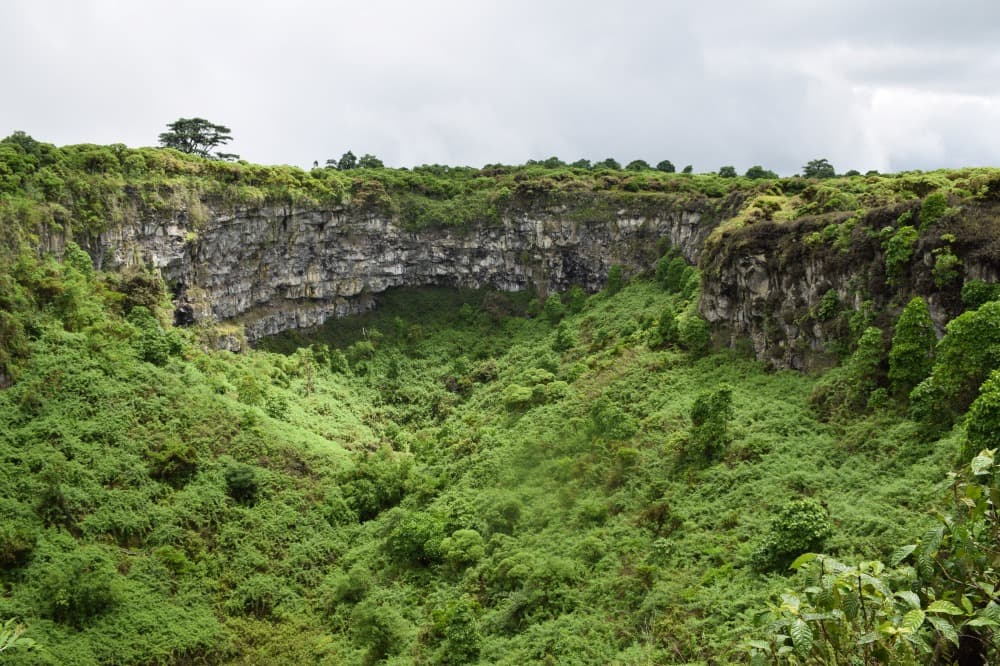
On the island of Santa Cruz in the Galápagos, Los Gemelos are two vast depressions formed by the collapse of ancient magma chambers, surrounded by a scalesia forest.
Los Gemelos, or Twin Craters, are two giant depressions located on the highlands of Santa Cruz island, in the Galápagos archipelago. Bordered by the main road that crosses the island, about twenty minutes' drive from Puerto Ayora, they can be observed from viewing platforms and constitute one of the must-see stops on an excursion into the central highlands of Santa Cruz.
Why visit Los Gemelos
The site offers a dual appeal. First, geological: despite their name, Los Gemelos are not volcanic craters but collapses of lava tunnels and magma chambers. Second, ecological: the two depressions are enveloped by a scalesia forest, a vegetation formation endemic to the highlands of the archipelago, which harbors dense bird life including several species of Darwin's finches.
The stop integrates easily into a day of exploring Santa Cruz's highlands, often combined with visits to the lava tunnels and giant tortoise reserves located nearby.
History and geological formation
Los Gemelos formed at a time when Santa Cruz was volcanically active. During lava flows, the surface of the lava solidified when exposed to air while the interior lava continued to flow, creating tunnels and underground chambers. Once the lava drained, these cavities remained empty. Under the effects of erosion and tectonic movements, their roofs collapsed, giving rise to these two vast depressions that face each other on either side of the road.
Each depression reaches a diameter of approximately 1.5 km. Their depth, sometimes subject to contradictory figures, falls in the range of several tens of meters. To capture the scale of the site in photographs, a wide-angle lens is useful.
What to see on site
The scalesia forest
The site is dominated by scalesia (Scalesia pedunculata), a tree endemic to the archipelago belonging to the daisy family. Reaching up to 15 meters in height, it is considered the largest daisy in the world. This species grows only on the highlands of the Galápagos, where fertile soil and high humidity favor it. Today it is threatened by goats and invasive plant species that compete with its young shoots.
On the ground and on tree trunks, you will also notice orchids and bromeliads that complete the picture of this humid highland forest.
A bird sanctuary
Los Gemelos and the surrounding forests harbor diverse bird life. The site is notably known for the presence of several of the eight species of Darwin's finches recorded in the archipelago. With a little patience, you may also observe the Galápagos dove, the short-eared owl, and the vermilion flycatcher, whose bright red plumage stands out against the green of the scalesia.
When to visit
The site is accessible year-round. The rainy season, from January to June, corresponds to the period when vegetation is densest and scalesia flowers open. It is also the most humid period: a waterproof windbreaker is useful. The dry season (July to December) offers a foggier atmosphere typical of the garúa, with heights often enveloped in low clouds.
For birdwatching, the early morning hours remain most favorable.
How to get there
Los Gemelos are found on either side of the main road that crosses Santa Cruz, approximately 20 minutes' drive from Puerto Ayora. Three options are available to you:
- By taxi: this is the simplest option. Negotiate the round-trip fare before leaving and ask the driver to wait for you.
- By bicycle: a bike path connects Puerto Ayora to the highlands. The climb is demanding, so plan to leave early to avoid the heat.
- With a guide: recommended option if you want explanations about geology and the ecosystem, often as part of a combined excursion with other highland sites.
Practical information
- Visit duration: plan approximately 1h30 to observe the two craters and walk the short trails that border them.
- Difficulty: very accessible, viewing platforms just a few minutes' walk from the roadside.
- What to bring: closed-toe shoes, water, waterproof clothing during rainy season, binoculars for birdwatching.
- Access: free, no specific entry fee for the site.
Nearby attractions
From your base in Puerto Ayora, several highland sites on Santa Cruz combine easily with Los Gemelos, notably the lava tunnels which complement understanding of the geological phenomenon observed at the Twin Craters. On the mainland, other Ecuadorian natural curiosities such as the Río Pastaza in the Amazon or El Nariz del Diablo in the Andes are also worth visiting.
Frequently asked questions
Frequently asked questions
No, despite their name of Twin Craters, they are not eruption craters. These are collapses of lava tunnels and magma chambers formed by ancient lava flows whose surface solidified while the interior continued to flow.
Approximately 1h30 is enough to observe the two depressions and walk the short trails that border them.
By taxi (approximately 20 minutes), by bicycle via the bike path that connects Puerto Ayora to the highlands, or as part of a guided excursion of the Santa Cruz highlands.
The rainy season (January to June) offers denser vegetation and scalesia flowering. The dry season is foggier but still pleasant. Early morning is ideal for birdwatching.
No, the site is freely accessible and observation is done from easily recognizable platforms. A guide remains useful for interpreting the geology and identifying wildlife.
Preparing your trip
Los Gemelos are part of a broader discovery of the Galápagos and continental Équateur. To build an itinerary that combines the archipelago, Andes, and Amazon, consult our tailor-made trips to Équateur.
Interested in this visit?
We can include it in your personalised itinerary.