Chimborazo
Chimborazo
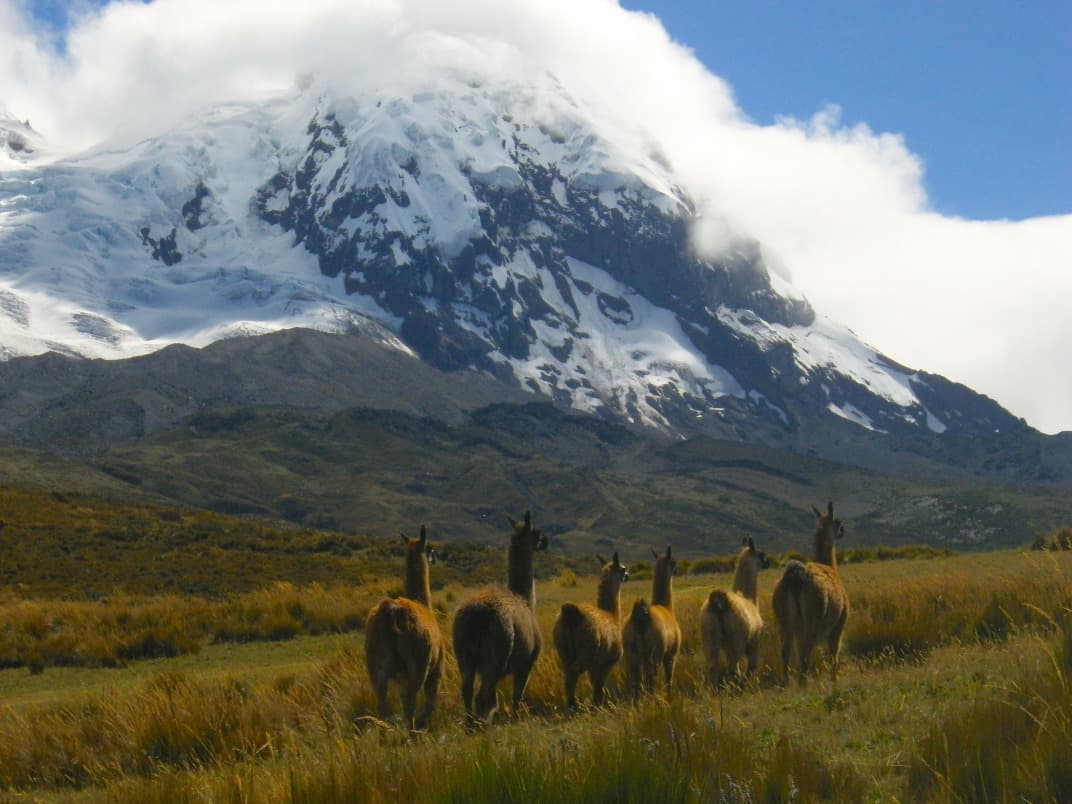
Ecuador's highest peak at 6,263 m, Chimborazo blends mythic mountaineering, páramo vicuñas, and high-altitude refuges in the heart of the Andes.
Located roughly 200 km south of Quito, northwest of the city of Riobamba, Chimborazo is a massive stratovolcano crowned with glacial caps that majestically dominates the arid plateau of the western Cordillera of the Andes. Considered Ecuador's highest peak and most isolated mountain, this giant of nature offers sweeping panoramic views of the surrounding valleys from its summit. Scaling its steep and formidable slopes promises alpinists exhilarating rewards.
History
Chimborazo volcano was first climbed on June 23, 1802, by Alexander von Humboldt. The renowned German naturalist faced considerable difficulties ascending to the summit due to altitude sickness. He suffered numerous symptoms—nausea, bleeding gums, hallucinations—that prevented him from reaching the top. It wasn't until 1880 that the summit was officially reached by a British alpinist known as Edward Whymper. The volcano's highest peak is actually named after this mountaineer.
Chimborazo is today considered an extinct and inactive volcano. However, according to recent studies, it could awaken. Its activity cycle spans approximately 1,000 years.
Today
The Chimborazo volcano forms part of the Andes Cordillera, at the principal extent of Ecuador's volcanic arc. It is surrounded by the mountains Carihuairazo, Tungurahua, Tulabug, and El Altar. Moreover, it is crowned by four summits: Whymper at 6,263 m elevation, Veintimilla at 6,230 m, Politecnica at 5,820 m, and Nicolas Martinez at 5,570 m.
With Whymper, the site's highest peak, Chimborazo ranks among the planet's loftiest and most distant summits from Earth's center. This is why its crown remains entirely ice-covered throughout the year. That said, as glacial mass has weakened and melted in recent years, it has become a vital water supply source for the population of Bolívar province.
Climbing to the Summit of This Natural Giant
Ascending Mount Chimborazo presents a genuine challenge, particularly for beginners. Oxygen scarcity makes breathing difficult. Its steep slopes are largely formed by sharp volcanic lava rock. For tourists keen on alpinism, cramponed boots are strongly recommended.
The route to the Chimborazo volcano's summit covers a 300 km itinerary. It includes Mount Fuya Fura, located at over 3,600 m elevation, and Imbabura at 4,630 m. Generally, the trek toward Chimborazo's summit begins in the city of Riobamba, capital of the province bearing the same name. This base camp is a compelling destination for community-based tourism. Furthermore, the region's typical dances and traditional attire of its indigenous inhabitants have forged its reputation.
Atop the volcano, mist and ice shroud the landscape. The natural scenery surrounding it rewards days of effort. Snowfalls on Chimborazo capture considerable attention from trekkers. Indeed, owing to its altitude and temperatures, a thick layer of snow accumulates on the volcano's slopes.
To reach Chimborazo volcano, the best approach is first to reach the city of Riobamba. You can take a bus from Guayaquil's bus terminal. It's also possible to board a Riobamba-bound bus at Quito's Quitumbe terminal. Once in town, you can take a bus or taxi and stop at the ticket office for the "Chimborazo Wildlife Production Reserve."
Want to discover this destination?
Our local advisors design your tailor-made trip.