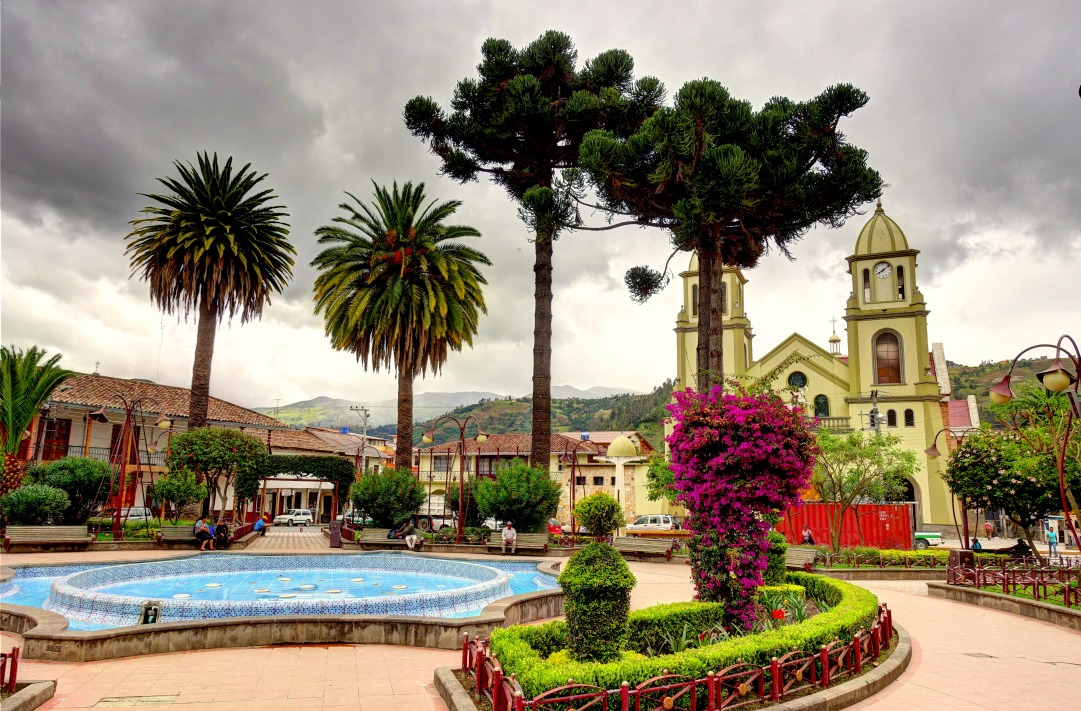
Baeza
Baeza
Two hours from Quito, Baeza marks the transition between the Andes and the Amazon jungle. Colonial heritage, rafting, and protected forest at 1,400 meters elevation.
As a cultural heritage site in Équateur, Baeza is a highly popular tourist destination. It's a perfect stopover at lower elevation before venturing into the Amazon jungle, especially for travelers who prefer to avoid high altitude. This place, rich with historical remnants, promises engaging tourist activities. It also benefits from a striking landscape thanks to its location within an Amazonian region of Équateur.
History
Baeza was officially founded on May 14, 1549, around the time the Spanish established the city of Quito. It takes its name from a Spanish city bearing the same name.
Until 1680, a series of catastrophes such as famine struck the city and surrounding regions. On December 11, 1578, an uprising of Indigenous people killed nearly all its inhabitants. As a result, the remaining residents left the city and settled in other regions. It wasn't until the Jesuits arrived in 1851 that the population began to grow.
Today
Situated midway between Quito and the Amazon forest in the Quijos River valley, Baeza is one of the largest cities in Napo Province. As the seat of the canton, it's one of the cities closest to the capital, Quito. Its population is primarily composed of the Indigenous Quijos-Quichua people, the first inhabitants of the Amazon. The city had approximately 1,220 residents in 2001.
Geographically, Baeza is organized into one urban parish and five rural parishes. The term "parish" is used in Équateur to designate municipal administrative divisions. Historically, however, the city is divided into two quarters: old Baeza, or Colonial Baeza, known as Baeza Antiguo.
New Baeza is flat, while old Baeza rises on a picturesque hillside. The colonial Baeza nevertheless holds great potential for tourist activities and hosts important historical remains. The quarter comprises 36 wooden houses of modest architecture, designed with small windows, large balconies, and courtyards in front and back. In 1995, following a request from the Ecodesarrollo Institute of Équateur's Amazon region, the old town of Baeza became a genuine national historical monument.
Hiking through thick jungle covering verdant mountains is among the most rewarding tourist activities. It allows hikers to discover and appreciate the Amazon ecosystem. Lasting about two hours, the itinerary begins in the city of Baeza, continues with a bike ride through the jungle, reaches the San Rafael waterfall, and concludes with a descent of 2,000 meters to the Tumbaco valley.
Located five minutes north of Baeza on the left bank of the Quijos River, the Ethnobotanical Reserve "Cumanda" stretches across a protected forest of 36,320 square kilometers. With very humid pre-montane characteristics, this place is home to numerous endemic species. During your visit, you can take walks, photograph, and observe the fauna and flora. You'll encounter iguanas, Andean rock cocks, parrots, Andean toucans, pava de monte (known as the Jacquinou Guan), squirrels, and cuchochu.
Plunging from a height of 150 meters, the San Rafael waterfall is the highest waterfall in Équateur. The water volume is incredible, leaving visitors breathless. At the base of the cascade, the falling water on the rocks generates an enormous mist that erupts like white clouds.
To discover the former side of Baeza, visiting the Baeza Museum is the most interesting approach. During your visit, you can admire 80 photographs of old Baeza and its surroundings. Permanent exhibitions and historical archives remind future generations of the city's history through the early 20th century. Some old objects once used by settlers are also displayed in the museum.
The old Baeza square is a true witness to nearly all of the city's sporting, social, civic, and cultural events. Very popular, this place has been transformed into an attractive tourist park and leisure complex. During a visit to this park, tourists can enjoy green spaces surrounded by fresh air revived by Amazonian tranquility.
Climate
Rising above 1,400 meters elevation in the midst of thick jungle, the Baeza region benefits, according to the Köppen-Geiger classification, from a warm oceanic climate. With an average precipitation rate of 865.5 mm, rainfall is very significant, especially in April, which is the most humid month. July is the driest month.
The average temperature is 14.1°C. It reaches 14.4°C in August and drops to 13.8°C in November, the coldest month of the year.
Good to know—On Friday, March 3, 1978, this city recorded a cold record of –4°C, a temperature never before seen in the region.
How to Get There
The "La Y" Intersection
Before reaching the Baeza region on your own, it's worth knowing about the "La Y" intersection, pronounced "La Yeh" in Ecuadorian Spanish. It's one of the region's most important intersections. It's a 2-kilometer fork that descends toward Baeza. The other direction at the intersection continues toward Baeza before connecting to the southeast of Tena and central Oriente.
Bus
Although the city of Baeza doesn't have its own bus terminal, it is served by buses from Quito heading to Tena. Buses stop in the center of New Baeza. Some buses from Quito to Lago Agrio pass 2 kilometers from Baeza and stop at "La Y."
Getting Around
To walk through the entire city takes only 10 minutes. The walk between the two Baeza quarters takes about 5 minutes.
What to Do in Baeza
- Explore the Ethnobotanical Reserve "Cumanda" to discover the Amazon ecosystem
- Discover the city's history by visiting the Baeza Museum and the colonial quarter
- Admire Équateur's highest waterfall, the San Rafael cascade
Want to discover this destination?
Our local advisors design your tailor-made trip.