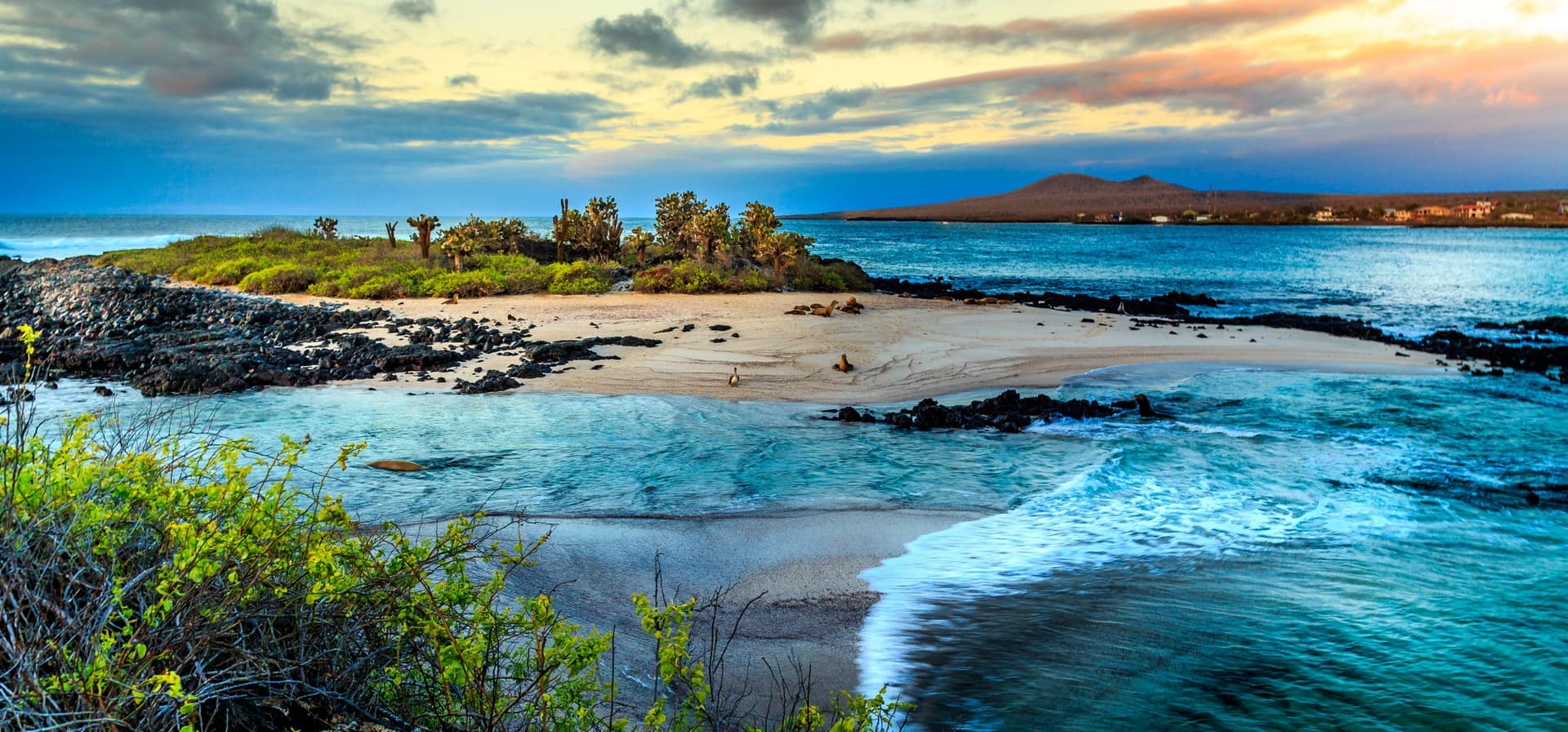
The Galápagos Islands
A volcanic archipelago in the Pacific Ocean, the Galápagos Islands are renowned for their incredible landscapes and the remarkably diverse, endemic wildlife that inhabits them. Located approximately 1000 km from Équateur's coast, the Galápagos are perceived as a lost paradise, a natural eldorado where human activity has yet to disrupt the delicate ecosystem.
A volcanic archipelago in the Pacific Ocean, the Galápagos Islands are renowned for their incredible landscapes and the remarkably diverse, endemic wildlife that inhabits them. Located approximately 1000 km from Équateur's coast, the Galápagos are perceived as a lost paradise, a natural eldorado where human activity has yet to disrupt the delicate ecosystem.
Its islands and the marine reserve surrounding them form a living jewel unique in the world. It comes as no surprise that UNESCO recognizes the archipelago and its marine reserve as "a living museum and a showcase of evolution". Though difficult to access, the Galápagos Islands remain a paradisiacal destination for discovering unparalleled fauna and flora. Allow yourself to be tempted by a stay in the Galápagos for an unforgettable experience in the heart of untamed nature.
History of the Galápagos Islands
No archaeological remains of ancient civilizations have been discovered in the Galápagos. It can thus be deduced that the islands were never colonized by humans. Lost in the middle of the Pacific Ocean, almost 1000 km from Équateur's coast, the probability of a landing on the archipelago is unlikely.
It was the Spanish bishop Fray Thomas de Berlanga, who was sent on a mission by King Charles V, who officially discovered the Galápagos in 1535. Upon landing on the islands, sailors discovered unusual animals (giant tortoises, iguanas…), but decided not to establish themselves there. According to Berlanga's description to the king, the islands had a perhaps overly wild character.
It was only from 1570 onwards that the islands began to be mentioned on maritime charts, including the map drawn in 1574 by Abraham Ortelius, under the name "Insulae de los Galopegoes". At this time, due to the mist that often covers the islands, they were called "Las Encantadas" (the "enchanted islands").
The Galápagos, until the end of the 17th century, served as a natural reservoir of food and water for passing ships. Whalers, buccaneers, and pirates found sources of fresh water, as well as giant tortoises, whales, and sea lions. These marine species served as food sources.
Patrick Watkins was the first settler of the Galápagos, who established himself on Floreana Island in 1807. He established a trading post for passing ships. In 1832, the Galápagos were annexed to Équateur, notably with Colonel Ignacio Hernandez, who took possession of the archipelago. All islands were renamed with Spanish names.
The most famous explorer of the islands was undoubtedly Charles Darwin, who set out to discover them in 1835. Amazed by the peculiar fauna developing on the islands, he particularly focused his studies on different species of finches. Upon his return, he developed, thanks to the various studies he conducted, his famous theory of the evolution of species, based on the mechanism of natural selection he was able to observe on site.
The colonization of the Galápagos accelerated, and in 1892, the islands became known as the Colon Archipelago. From 1934, laws protecting the Galápagos Islands were decreed and part of the archipelago was transformed into a National Park. Unfortunately, during World War II, Baltra Island was used as an American air base. This led to the extermination of land iguanas.
In 1959, the entire archipelago was declared a National Park. It was also the year of the creation of the Darwin Foundation in Brussels, whose objective is to raise funds for the preservation of the Galápagos' biodiversity.
In 1968, the Galápagos National Park Service was established. Its primary function is to delineate tourist zones in order to channel visitors and prevent contamination from outside sources (seeds, animals…). In 1978, the Galápagos became the first archipelago to be part of UNESCO's World Heritage.
The Galápagos Today
The Galápagos archipelago holds treasures and marvels, attracting an increasing number of tourists each year who wish to explore its beautiful white-sand beaches and discover unique and varied wildlife.
The Galápagos are a small archipelago located more than 1000 kilometers west of the continent, in the Pacific Ocean. It comprises about ten main islands, of which 4 are inhabited, and numerous islets, all of volcanic origin. The Galápagos Islands are bordered by one of the world's largest marine reserves, totaling 133,000 km².
Beyond the three largest islands San Cristobal, Santa Cruz, and Isabela, it is equally interesting to visit the lesser-known islands. Española, Floreana, Bartolomé, Santa Fe, and Fernandina are among the jewels of the Galápagos, displaying high tourism potential. Each island has its own particularity, its own landscapes, and sometimes endemic fauna.
The Galápagos can be discovered in different ways, the most well-known being aboard a cruise ship or by discovering one island at a time (also called Island Hopping). In any case, you must fill out a "transit card" (10 USD) and pay the entrance fee to the Galápagos National Park, which costs 100 USD. But whatever way you choose to discover the Galápagos, the tourist itineraries are fixed in advance and regulated to preserve local fauna and flora.
The Galápagos, an Authentic Jewel to Preserve
Thanks to its numerous natural zones, promoting the preservation of fauna and flora, this archipelago is known as being a luxurious eco-tourism destination.
It should also be said that the islands are populated with incredible and sometimes endemic animals, such as Galápagos land and marine iguanas, or the famous giant tortoises. In fact, the latter gave their name to the archipelago.
Visits to the islands of the Galápagos archipelago, also called the "Colon Archipelago", are strictly regulated and must be conducted only in the company of a guide. While not completely untouched, the vast majority is now protected. Tourist flows are channeled and regulated for the greatest benefit of wildlife and nature lovers.
Only a few islands are inhabited and spaces are relatively restricted in order to maximally protect natural areas. The uninhabited islands, meanwhile, are subject to strict control, where tourist circuits are meticulously planned in advance. The goal is nonetheless to limit the number of visitors.
Despite all these measures and its inscription as a UNESCO World Heritage Site, local fauna is today in danger. Increasingly dense human populations and perpetually growing tourism are unfortunately the main causes. Thus, since 2007, the Galápagos have been inscribed on the list of World Heritage Sites in Peril.
Green Tourism Throughout the Galápagos
The Galápagos are assuredly one of the most beautiful destinations on the planet. Visiting this archipelago is a waking dream for nature lovers. The islands deploy a unique ecosystem in the world.
Exceptional Fauna
Since the human population on the Galápagos Islands only dates back to the 19th century, the archipelago's fauna has remained nearly intact. The fauna is unique in the Galápagos National Park. Among the best-known animals, we can mention giant tortoises, colorful lizards, sea lions, and iguanas (land and marine).
The archipelago is also home to 58 bird species, of which 28 are endemic. Frigatebirds, finches with varied beaks, albatrosses, birds of paradise, and blue-footed and red-footed boobies … are some of the bird species most sought after by visitors.
The Galápagos marine reserve offers the spectacle of impressive living underwater flora and fauna. Among the most surprising mammals are the Galápagos fur seal, the humpback whale, and the Galápagos shark. The reserve also contains more than 300 fish species, enough to make every experienced diver dream.
Magnificent Flora
Beyond very rich and sometimes endemic fauna, the Galápagos also harbor incredibly varied flora! There are more than 850 plant species, of which 228 are said to be endemic. Each island has its own characteristics in terms of vegetation, which is explained by differences in terrain and climate between each island.
On the coasts, several species are found such as mangrove, purslane, and myrtle, which are rather aquatic species, while inland and in arid zones, lichens and cacti are generally found.
At altitude, humidity favors the presence of locusts, guavas, passion flowers, and lichens.
The Galápagos, an Unforgettable Journey in the Heart of a Remote Paradise
The main islands are Isabela, Santa Cruz, San Cristóbal, Santiago, and Fernandina, nicknamed "the enchanted islands".
Santa Cruz is the most important of the Galápagos Islands in terms of activity. You can first stroll along the port of the city Puerto Ayora. The water is beautifully blue, but swimming is prohibited. Santa Cruz draws many tourists because the island is home to the Charles Darwin Research Center and its giant tortoise reserve, the Van Straelen Museum, and the Cerro Dragon site for observing iguanas. This island is also known for the magnificent expanse of white sand at Tortuga Bay, populated by sea lions, and Las Grietas, a transparent natural freshwater spring conducive to snorkeling.
After Santa Cruz, San Cristobal is the second island of the archipelago in terms of tourist infrastructure. It is accessible by ferry from Santa Cruz or by direct flight from Équateur. The Kicker Rock, one of the most beautiful diving sites in the Galápagos, is a must-see on the island.
Isabela Island, the largest of the Galápagos Islands, is also worth a visit, particularly for hiking to the Sierra Negra volcano or contemplating an impressive lunar landscape. On Isabela, you can also enjoy the view of giant tortoises roaming in the Arnaldo Tupiza Breeding Center.
Santiago Island is among the uninhabited Galápagos Islands accessible via a cruise. It is of interest for Espumilla Beach, a magnificent bay with white sand, or the beautiful view of the Bartolomé islet.
Fernandina is the youngest island of the archipelago and the most preserved. No non-endemic species has yet been introduced there. At its landing point Punta Espinoza, one discovers lava landscapes and intriguing cacti. Hundreds of marine iguanas inhabit this island with its lunar scenery.
Climate on the Galápagos Archipelago
The Galápagos Islands offer a tropical, dry climate. In the Galápagos, the temperature is not stifling, despite the fact that the archipelago is located on the Equator. The rainy season is between January and May. This is the sunniest period of the year, with water temperatures reaching up to 25°C and air temperatures not exceeding 30°C. From June to December is the dry season. Long periods of mist can occur, however the sun remains present. The water temperature, which is cool, hovers around 20°C in the morning and reaches 25°C in the afternoon. Be aware, however, that even in cooler weather, the sun can be scorching. Therefore, a hat, sunglasses, and sunscreen are required.
Located approximately 1000 km from the continent, the archipelago is primarily accessible by air. Flights depart from Quito or Guayaquil to reach one of the two airports in the archipelago: Baltra, the airport serving Santa Cruz Island, and San Cristóbal.
Isabela Island is only accessible from the other 2 islands, and not directly from the continent. Allow 1.5-3 hours of travel depending on your departure airport.