Latacunga
Latacunga
At 2,800 meters above sea level, Latacunga is the ideal base for exploring Cotopaxi volcano, Quilotoa lake, and the indigenous markets of the Ecuadorian Andes.
Latacunga is the capital of Cotopaxi province in central Équateur. Located just two hours by road from Quito, this city holds modest mainstream tourist appeal. Its true charm lies in its strategic location. Indeed, it serves as the gateway to Cotopaxi National Park, with its snow-capped volcanic peak, and to Quilotoa lake, which stretches across a crater. During your visit to the region, you'll discover rural Équateur, with its indigenous markets. Moreover, if your travels coincide with September or November, you'll have the chance to experience the city's famous festival, Mama Negra.
History
Latacunga was founded by the Spanish in 1534 under the original name Asiento de San Vicente Mártir de Latacunga. The city held great economic and political significance during the colonial era. It freed itself from Spanish rule on November 11, 1820. Its population stood at 63,842 inhabitants in 2010.
Latacunga Today
Latacunga ranks among the principal urban, economic, and financial centers of central Équateur. Its economy rests on diverse industries—floriculture, mining, metallurgy, dairy production, and more. The city also boasts large markets and modern shopping centers, making it an important commercial hub throughout the country.
What to Do in Latacunga and the Surrounding Area?
Explore the City
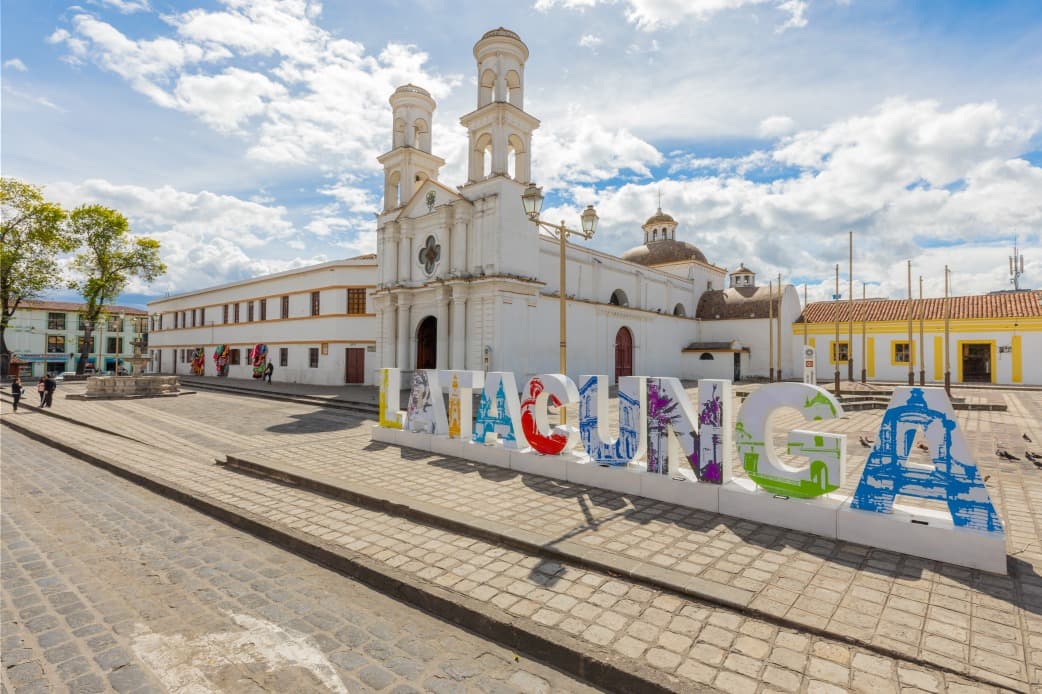
While it may not rival Cuenca with its splendid architecture, Latacunga rewards urban explorers with genuine character. The city was the religious center of the region during the Spanish era. Several photogenic churches still grace its downtown. You'll find the Iglesia Católica La Merced, the Iglesia De Santo Domingo, and La Catedral.
Visit Traditional Markets
Unlike the Otavalo market, the markets in this region aren't oriented toward tourists. This allows you to experience rural Équateur in its most authentic form. Visit these markets to soak in local life. Merchants offer a remarkable variety of goods—food, clothing, handicrafts, and livestock. The most notable market sites are found in Sigchos, Saquisili, and Guantualo.
Visit Cotopaxi National Park
Cotopaxi National Park is dominated by the volcano of the same name, which rises to 5,897 meters above sea level. It's Équateur's second-highest peak, after Chimborazo (6,268 meters). With a guide, you can attempt the summit or hike to a breathtaking refuge perched at 4,500 meters altitude. Trekking isn't the park's only offering. The protected area also invites mountain biking and horseback riding. It's worth noting that the volcano remains active. Before venturing forth, check with local authorities about current conditions.
Marvel at Quilotoa Lake
Quilotoa lake ranks among Équateur's finest attractions. Nestled near Latacunga at nearly 4,000 meters altitude, its color—emerald or intense turquoise—shifts with the light and weather conditions.
Trek the Quilotoa Loop
The Quilotoa Loop immerses you completely in this region's enchanting landscape, with its farmland, countless small villages, dormant volcanoes, and more. Its popularity has grown steadily since it was properly marked. Spanning 200 kilometers, this loop begins and ends in Latacunga. Plan two to three days to complete it.
Attend the Mama Negra Festival
Each year, numerous festivals unfold in Latacunga. The most celebrated is Mama Negra, designated as intangible cultural heritage of Équateur. It's celebrated on September 23 and 24, and again on November 11, during the city's Independence Day. Blending indigenous, Spanish, and African traditions, this celebration honors the Virgin of the Merced church, also known as Our Lady of the Volcano.
Discover Tigua Paintings
Tigua is a small village an hour from Latacunga. The locality is renowned for its paintings, whose origins trace back to the Inca and pre-Inca eras. These artworks are executed on sheepskin canvases and depict the daily life of indigenous peoples or local legends. They display vibrant colors that captivate the eye.
Practical Information
When to Visit?
Latacunga enjoys a springlike climate year-round, with an average annual temperature of 13.6 °C. The region experiences two seasons: a mild and rainy winter stretching from October to May, and a dry, cool "summer" from June to September. Naturally, the second season is ideal for a visit. You can also extend your stay into November, the warmest month of the year, averaging 15.1 °C.
How to Get There?
The city sits on the Pan-American Highway. It's accessible by bus and train from Quito. If you prefer to arrive quickly, the town has an airport with connections to other cities throughout Équateur and beyond.
Want to discover this destination?
Our local advisors design your tailor-made trip.