Charles Darwin Research Station
Charles Darwin Research Station
An iconic scientific hub of the Galápagos, the Charles Darwin Research Station in Puerto Ayora hosts a giant tortoise breeding programme and the Lonesome George exhibition. Free entry, walking distance from the waterfront.
The Charles Darwin Research Station, founded in 1964 in Puerto Ayora on Santa Cruz island, stands as the Galápagos' foremost scientific centre. It houses a captive-breeding programme for giant tortoises, active laboratories, and a conservation mission that has shaped archipelago management for six decades. It remains one of the few places to observe giant tortoises up close, in a rigorously educational setting.
Practical essentials at a glance
- Entry: free (the station is open to the public)
- Recommended duration: 1 to 1.5 hours
- Dress code: no restrictions; closed-toe shoes recommended on trails
- Access: on foot from central Puerto Ayora, following the waterfront
- Accessibility: main pathways are passable; some dirt trails remain challenging
What you'll see
The heart of the visit is the giant tortoise breeding centre: enclosures house individuals from several island species, from hatchlings to century-old adults. Signage explains the reintroduction programmes conducted island by island. You'll also find land iguanas in semi-wild conditions, exhibitions on the archipelago's biodiversity, and a botanical garden of endemic plants.
History and context
The Charles Darwin Foundation, an international non-profit organisation, established the station in partnership with the IUCN and UNESCO. It played a decisive role in saving the Española island giant tortoise, reduced to just fifteen individuals in the 1960s: the breeding programme has allowed over two thousand tortoises to be reintroduced. The station bears the name of the British naturalist whose 1835 visit to the Galápagos inspired the theory of evolution.
Highlights of the visit
The giant tortoise enclosures
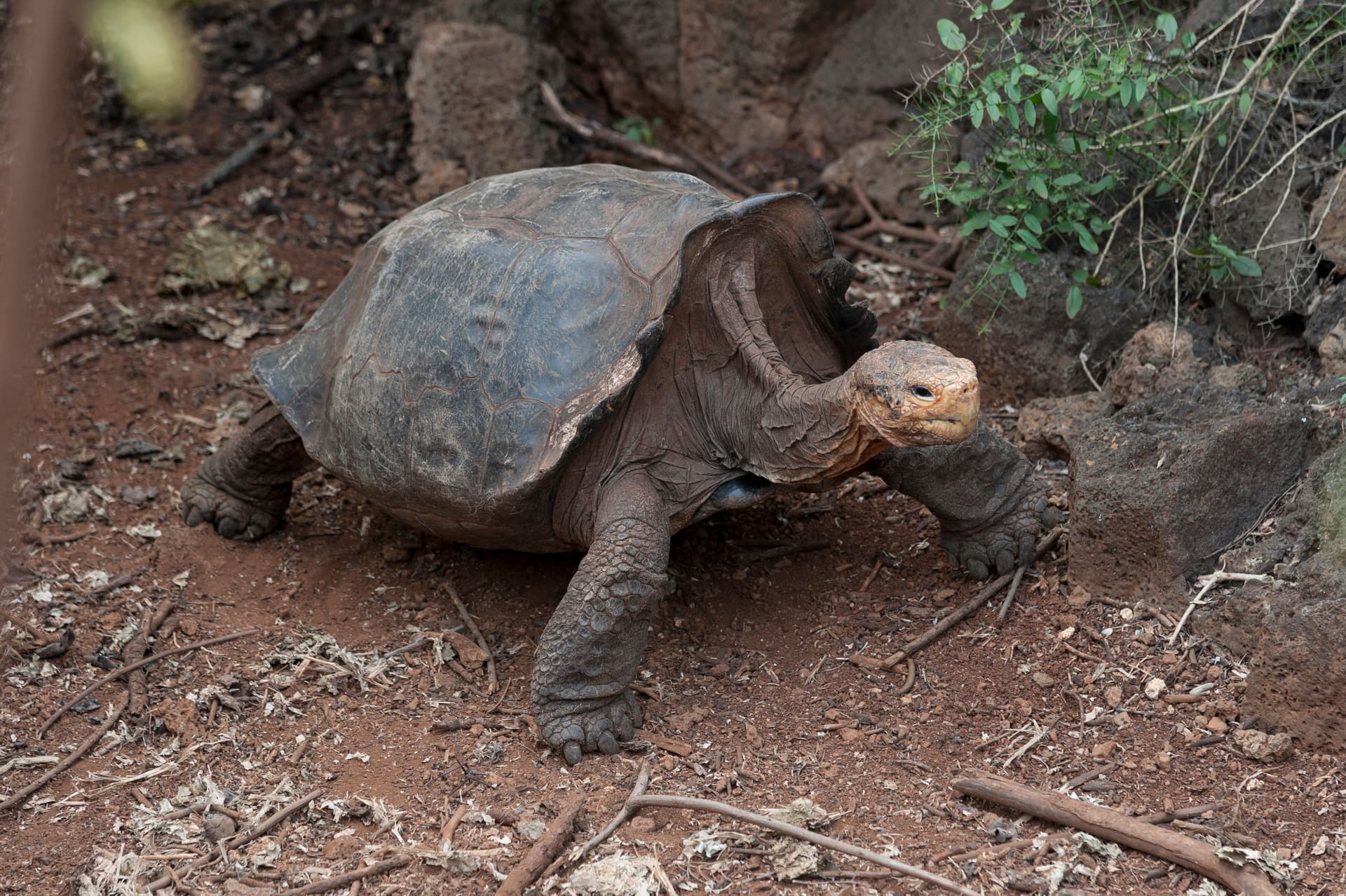
Galápagos giant tortoises can exceed 200 kg and live over a century. The enclosures allow you to observe their natural behaviour just metres away, without glass barriers. Plaques indicate each group's species and island of origin.
The hatchery
Young tortoises, called hatchlings, are raised in the hatchery for several years before release. Observing these tiny creatures—barely a few centimetres—alongside the enormous adults brings the scale of the conservation programme into sharp focus.
The Lonesome George memorial
Lonesome George, the last representative of the Chelonoidis abingdonii subspecies from Pinta island, died in 2012. His taxidermied specimen is displayed at the station: a global symbol of extinction and the limits of conservation.
Photography tips
Morning light is softer and tortoises are often active early. Avoid flash in covered areas. Enclosures offer ground-level angles for expressive portraits. Giant cacti in the background reinforce the endemic character of your shots. Do not approach animals closer than one metre.
Location and access
The station sits at the eastern tip of Puerto Ayora's waterfront, accessible on foot in around fifteen minutes from the main jetty. The path follows Academy Bay and passes several restaurants and shops. No special transport is needed. Guided tours are offered by local agencies in Puerto Ayora, often combined with other Santa Cruz sites.
Nearby
- Los Gemelos — two collapsed craters in the heart of Santa Cruz island, surrounded by Scalesia forest.
- Tortuga Bay — white sand beach 45 minutes on foot from Puerto Ayora, frequented by marine iguanas and rays.
- Las Grietas — a geological fissure filled with crystalline seawater, ideal for swimming and snorkelling.
- Academy Bay beach — Puerto Ayora's urban beach where sea lions and pelicans coexist with visitors.
Frequently asked questions
Access to the Charles Darwin Research Station is free. However, the Galápagos National Park entrance fee, paid on arrival in the archipelago, is mandatory for any stay on the islands.
No. It is forbidden to touch animals anywhere on the station grounds. National park rules apply: maintain at least one metre distance from wildlife.
One to one and a half hours is sufficient to tour the enclosures, hatchery, and the Lonesome George exhibition. Allow more time if you wish to read the scientific plaques in detail.
Yes. The tortoise enclosures and hatchery are particularly enjoyed by children. The pathways are wide and shaded. Bring water and sunscreen; the heat can be intense mid-day.
Easily. Visit the station in the morning; in the afternoon, Tortuga Bay or Las Grietas are reachable on foot from Puerto Ayora. Los Gemelos, in the highlands, requires a taxi or organised tour.
The station has a shop offering scientific publications and items, with sales supporting conservation programmes. There is no food service on site; Puerto Ayora offers many options within a short walk.
Want to discover this destination?
Our local advisors design your tailor-made trip.